
Lượt xem: 4.015
Should You Try a Chemical Peel for Melasma? Heartfelt Advice From a Specialist
Hi everyone, it’s me again—your familiar companion in the world of science-based beauty and skincare.
Melasma—just hearing those two words already feels “heavy” for many women, especially once we pass the age of 30.
Those uneven, brownish patches across the cheekbones don’t just affect appearance—they can instantly make us look older and feel less confident in daily communication.
Among countless melasma treatments today—such as topical creams, laser treatments, mesotherapy injections—chemical peeling (also known as a “medical peel” or “skin resurfacing peel”) has recently become a real trend.
When you see ads showing skin peeling off in sheets and revealing a fresh, rosy-white layer underneath, many people feel both tempted… and terrified.
My inbox has been flooded with the same question lately:
“Is a chemical peel for melasma worth trying? Will it make my skin thinner?”
Honestly, this is a very good question—and it deserves a clear explanation based on science, not rumors.
So today, let’s “dissect” this method properly and find out whether it truly deserves your trust—and your precious skin.
The Science: What Is a Chemical Peel for Melasma, Really?
Before deciding whether you should try peeling for melasma, you need to understand what it actually is—so you don’t confuse it with harsh peeling creams or shady “mixing creams” sold online.
A chemical peel is a procedure that uses chemical solutions—often naturally derived acids (organic acids)—to act on the skin’s surface.
Its purpose is to remove:
-
dead, aged skin cells
-
dirt and buildup
-
bacteria
-
and most importantly, melanin pigment located in the upper layers of the skin (epidermis)
Think of your skin like a tree: when the outer bark becomes rough and dark, it needs to be removed so healthier skin underneath can be revealed.
Peeling agents work by breaking down the bonds between old keratinized cells, encouraging them to shed naturally—almost like a snake shedding its skin.
At the same time, this process sends a “repair signal” deeper into the skin, stimulating the body to boost collagen and elastin production to rebuild fresh skin.
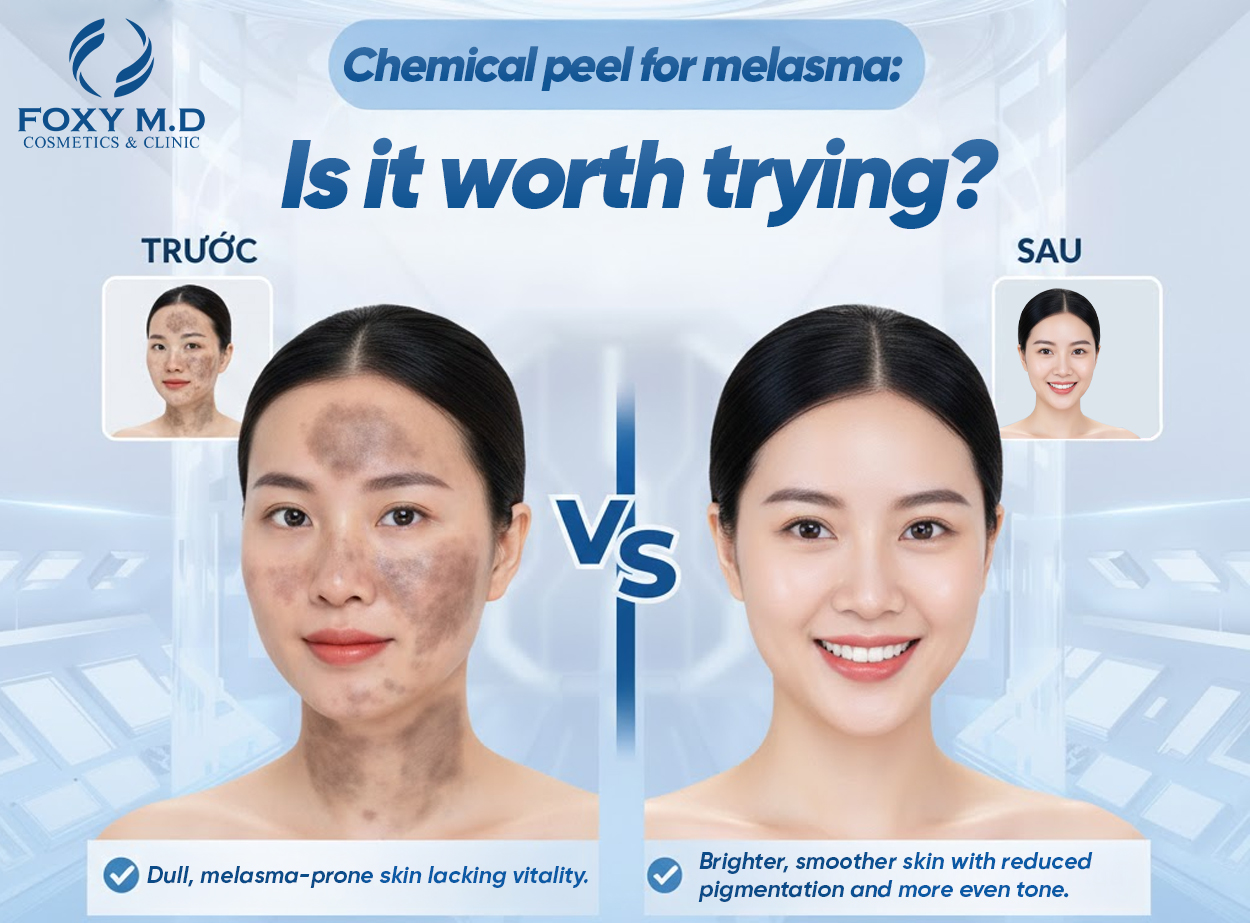
That new layer tends to look smoother, pores appear smaller, and—most noticeably—superficial melasma patches fade, because pigmented cells are removed along with the older layer.
However, chemical peeling is not as simple as daily face washing. It is generally categorized into three levels:
-
Superficial peels: affect only the outermost layer; mainly brighten, clean pores, and help acne; minimal peeling
-
Medium peels: reach deeper into the epidermis; help with pigmentation, mild wrinkles; peeling often lasts 3–5 days
-
Deep peels: reach the dermis; used for deep wrinkles or scars; higher risk and must be performed by highly experienced medical professionals
So with this mechanism… should we “take the risk”? Let’s analyze further.
Deep Analysis: Is a Chemical Peel for Melasma Worth Trying?
This is the million-dollar question.
To answer honestly, I’ll break it down into two parts: real benefits vs. potential risks.
Benefits (Pros)
First, peeling can fade melasma faster than skincare creams alone.
Acids target surface pigment directly, often helping the skin look noticeably brighter after a short course.
Second, it improves overall skin quality—not just melasma.
Peels can also help with acne, clogged pores, oil control, texture refinement, and fine lines.
Third, peels are often more budget-friendly than high-tech lasers (like Pico lasers or CO2 fractional lasers).
This makes them a more affordable option if you want improvement but have a limited budget.
Fourth, peels boost absorption of other treatments.
Once the thick dead-skin layer is removed, serums and brightening products penetrate more effectively.
Risks (Cons)
Chemical peels are not for everyone—especially if your skin is thin, fragile, highly sensitive, or has visible broken capillaries.
If the acid strength or timing isn’t controlled correctly, peeling can cause burns, irritation, and prolonged redness.
The biggest fear is post-inflammatory hyperpigmentation (PIH).
If you don’t protect your skin properly after a peel—especially from sunlight—new skin can darken quickly, sometimes making melasma worse than before.
So… should you try a peel for melasma?
✅ Yes—if your skin barrier is strong, your melasma is mostly superficial (epidermal/melasma patches), and you do it at a reputable clinic.
❌ No—if your skin is irritated, weak, overly sensitive, or you plan to peel at home without proper knowledge.
The “Gold Standard” Ingredients Commonly Used in Peels for Melasma
To help you avoid feeling lost in the “chemical name maze,” here are the most commonly used peeling agents for pigmentation:
1) Glycolic Acid (AHA)
Derived from sugarcane, with a very small molecule size—so it penetrates quickly.
It’s excellent for exfoliating pigmented surface cells, brightening, and boosting collagen.
Best for aging skin, patchy melasma, and normal-to-dry skin.
2) Salicylic Acid (BHA)
Derived from willow bark and oil-soluble.
Famous for acne, but also helps pigmentation by clearing pores and reducing inflammation.
Often combined with other acids.
3) Trichloroacetic Acid (TCA)
A stronger agent used in medium-to-deep peels.
It can target stubborn pigment but has a higher risk of burning if done incorrectly.
Never use TCA at home.
4) Retinol (Vitamin A)
Retinol peels may feel gentler during treatment, but peeling often shows up 2–3 days later.
It helps normalize skin turnover and reduces melanin formation.
5) Jessner’s Solution
A mix of resorcinol, lactic acid, and salicylic acid in alcohol.
This combo can treat melasma, acne, and aging effects while reducing side effects compared to using very high concentrations of a single acid.
At clinics like Foxy M.D, doctors often customize a “cocktail” formula rather than using only one acid—so the treatment is tailored and more effective.
A Medical-Standard Melasma Peel Procedure at Foxy M.D (Da Nang)
One key factor in deciding whether a peel is worth trying is the procedure itself.
At Foxy M.D Cosmetics & Clinic, the peel process is standardized for safety:
-
1:1 Consultation & Skin Scan
Doctor evaluates melasma type (superficial, deep, mixed) and skin strength. -
Deep Cleansing
Skin is cleaned thoroughly, then sensitive areas (eye corners, nose folds, lip corners) are protected with Vaseline to prevent burns. -
Peeling Step
A trained professional applies the acid evenly in the correct sequence.
You may feel mild stinging or warmth—this is normal. -
Neutralization
This step stops the acid reaction and restores skin pH—very important for safety. -
Soothing & Recovery
Mask, LED therapy, or infusion with repairing ingredients (B5, HA) to calm and hydrate the skin. -
Moisturizer + Sunscreen
You leave with protected skin and aftercare instructions.
A peel isn’t just “putting acid on your face”—it’s the art of controlling skin reaction. Proper doctor supervision helps avoid complications like over-burning (excessive frosting).
How Much Does a Melasma Peel Cost?
In Da Nang, a medical-standard melasma peel typically ranges from 800,000 VND to 3,000,000 VND per session, depending on:
-
the brand and quality of the peeling solution
-
the doctor’s expertise
-
the clinic’s facilities and recovery support
Be cautious with ultra-cheap peeling deals (99k, 199k).
It may be basic exfoliation—not true medical peeling—or low-quality products with higher risk.
For melasma, peels usually require 3–5 sessions, spaced 2–4 weeks apart, to maximize results.
Deadly Mistakes When Peeling for Melasma at Home
Many people watch online videos and try to “be their own doctor.” This is extremely risky.
Common mistakes include:
-
choosing the wrong concentration (strong acids can cause deep burns and permanent scarring)
-
peeling on inflamed acne or damaged skin (can worsen breakouts)
-
not knowing how to neutralize the acid (leaving it too long causes deeper injury)
-
poor sun protection (pigment rebound can be 10x worse)
So the honest answer is: Don’t try professional-level peels at home unless you truly have medical knowledge.
Aftercare: How to Prevent Melasma from Coming Back After a Peel
Aftercare is 50% of success.
Days 1–3
Skin may be red, tight, dry, and can look darker temporarily (pigment rising to the surface).
Use only gentle cleansing (saline or cooled boiled water).
Apply repairing products (B5, HA) frequently.
Days 4–7
Skin begins peeling—light flakes or small patches.
Golden rule: DO NOT pick or peel the skin manually.
Let it shed naturally.
Sun protection is critical—SPF 50+ multiple times daily, even indoors.
After Day 7
New skin looks fresher and smoother.
Continue moisturizer and sunscreen.
You can gradually reintroduce brightening serums (Vitamin C, arbutin), starting slowly.
FAQ
1) Does peeling make skin thinner?
If done correctly and not overdone, no—it can actually stimulate collagen and strengthen skin. Over-peeling too often is what causes damage.
2) Does peeling hurt?
You may feel mild stinging or heat for a few minutes. Once neutralized, discomfort decreases quickly. Most people can tolerate it easily.
3) Can acne + melasma skin do peels?
Yes—especially with BHA or Jessner peels that help acne and pigmentation together.
4) How often should you peel?
Superficial: every 2–3 weeks.
Medium: every 4–6 weeks.
5) Can peeling completely remove deep melasma?
Peels are great for superficial melasma. Deep dermal melasma usually needs combination treatment (laser, meso, oral medication).
Conclusion
So—should you try a chemical peel for melasma?
Yes, it’s a scientific, effective option and absolutely worth considering if you want to “refresh” your skin and speed up your melasma journey.
It’s not magic, but it’s a powerful tool.
However, high effectiveness comes with the need for proper medical technique and knowledge.
Don’t turn your skin into a home experiment.
If you’re in Da Nang and struggling with stubborn melasma, feel free to visit Foxy M.D Cosmetics & Clinic at 288 Nguyen Van Linh Street. The team is ready to scan your skin, listen to your concerns, and create a safe, personalized peeling plan for you.
Wishing you always stay beautiful, radiant, and successful in life!