Lượt xem: 4.015

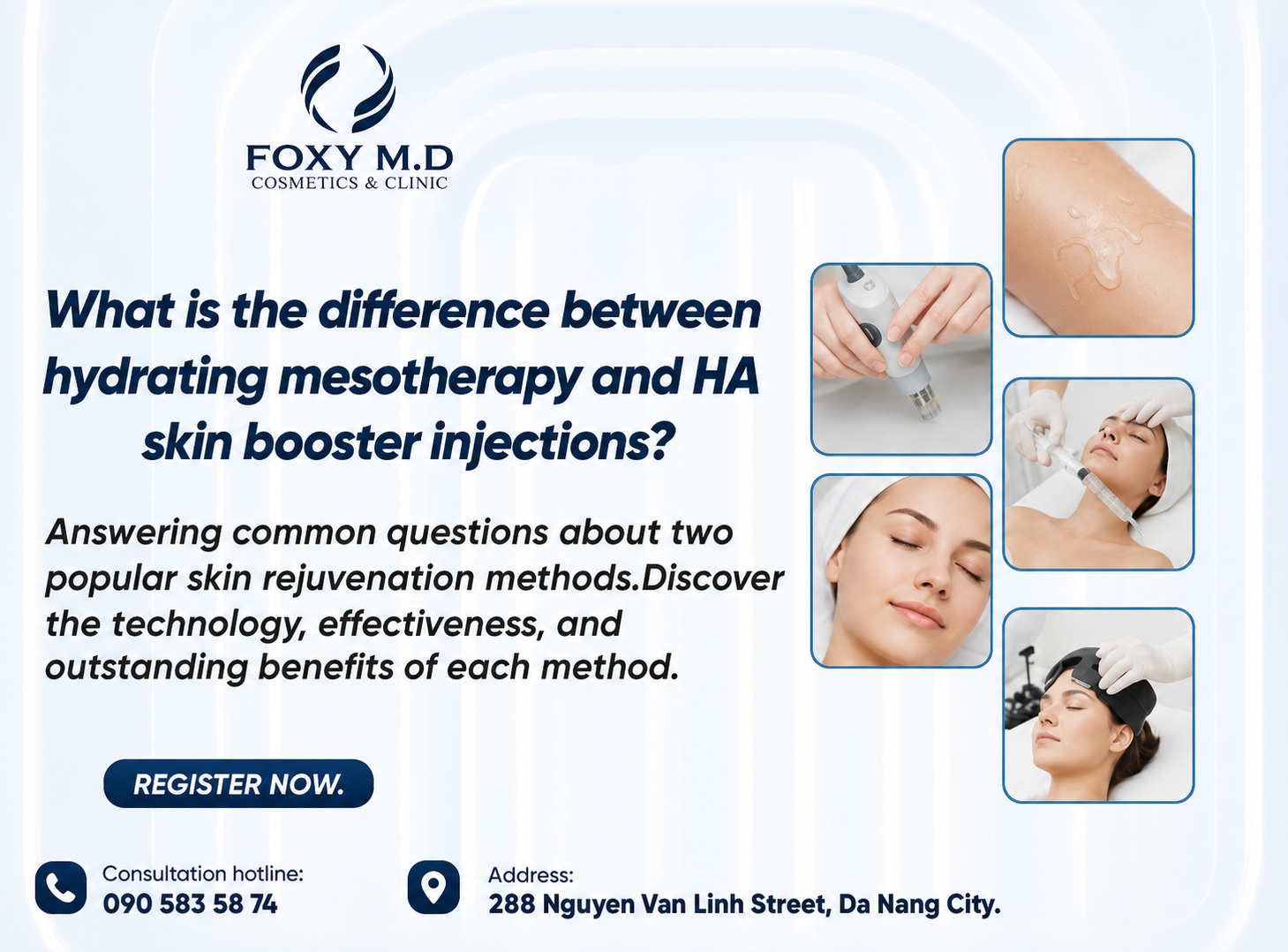
However, in this maze of aesthetic terminology, I’ve noticed many of you are feeling overwhelmed and confused. The most common question I receive is:
“Sis, what’s the difference between hydrating mesotherapy and HA skin boosting? I thought they were the same thing?”
In reality, the line between these two concepts is quite thin — and it’s often blurred by misleading spa advertising, which leaves customers even more confused. Although the final goal is the same (a dewy, hydrated complexion), the pathway and the “weapons” used are fundamentally different.
Today, as someone who loves researching skin science and has personally experienced these treatments at Foxy M.D Cosmetics & Clinic, I’ll help you decode this topic clearly and thoroughly. Let’s uncover the truth your skin deserves — right in this article.
To tell the difference, we must first understand what each term truly means. This is the foundation that prevents you from being led around by “too good to be true” marketing.
Mesotherapy is not the name of a substance — it’s the name of an injection technique.
This method uses ultra-fine needles to deliver nutrients (medications, vitamins, enzymes, etc.) into the dermis (the middle layer of the skin).
Put simply, mesotherapy is like a delivery vehicle. That “vehicle” can carry many types of “cargo” depending on the treatment goal: acne control, pigmentation correction, fat-dissolving agents, or hydrating nutrients.
Unlike mesotherapy, HA is not a technique — it is a hydrating ingredient.
Hyaluronic Acid is a sugar molecule naturally found in our body, famously known for its superior water-holding capacity (1 HA molecule can hold up to 1,000 times its weight in water).
So when people say “HA boosting” or “HA injection,” they’re talking about delivering HA itself into the skin. And to deliver HA, many providers use the mesotherapy technique.
At this point, you may already see the logic:
Meso = the method
HA = one possible ingredient delivered by that method
However, in modern aesthetic marketing, “Hydrating Meso” and “HA Skin Booster” are often separated into two different services — with distinct characteristics. Let’s break it down clearly below.
Based on treatment information and real-world service models at reputable clinics like Foxy M.D, here’s a clear comparison.
The key differences come down to three major factors:
Active ingredients
Technique and injection depth
Treatment results
Hydrating mesotherapy typically uses a cocktail formula: HA in moderate concentration combined with multiple other skin nutrients such as:
Vitamins (C, E, B-complex)
Amino acids
Minerals
Peptides
Coenzymes, etc.
The goal is whole-skin nourishment — not just hydration, but also brighter tone, stronger barrier function, antioxidant protection, and overall skin recovery.
HA boosting (often called a skin booster) usually uses high-purity HA at a higher concentration.
This HA may be:
cross-linked (for longer-lasting hydration and bounce), or
non-cross-linked but with larger molecular structure, depending on the product type.
The primary goal is maximum deep hydration and a strong, visible “glassy” glow (often described as the Korean “mulwang” effect).
Think of it like pumping a large volume of water into a reservoir to create that smooth, plump surface instantly.
Hydrating meso is usually delivered through multiple tiny micro-injections across the face, either manually or with a meso gun (Mesogun). It targets the superficial to mid-dermis.
The bumps are usually small, minimal swelling, and often fade within a few hours. This method creates micro-channels that help deliver nutrients evenly across a wide area.
HA boosters often use:
BAP technique (Bio Aesthetic Points — e.g., 5 points per side of the face), or
visible papules (larger “bumps” containing HA)
The product is typically placed deeper in the dermis or even into the superficial fat layer so that HA spreads gradually.
Because HA is thicker and more concentrated, bumps may last longer (often 12–48 hours) if injected via papules.
The BAP technique, however, reduces injection sites — meaning less pain and less bruising.
Hydrating meso tends to improve overall skin quality:
brighter tone
more even complexion
smoother texture
stronger, healthier skin from within
The glow is typically natural and healthy, not overly “wet-looking.”
It’s especially suitable for:
tired, dull skin
enlarged pores
mild early aging
combination concerns (dry + dull + rough)
HA boosting creates a more dramatic hydration effect — producing very visible glass skin, strong plumpness, and fast bounce.
It can help:
soften fine lines caused by dehydration
improve elasticity and firmness quickly
create that “ready for event” dewy finish
This is ideal for:
extremely dry, flaky skin
mature skin needing deep hydration support
anyone wanting a quick glow for parties, weddings, or special events
Now that you understand the difference between hydrating meso and HA boosting, you might be asking:
“So what should I do for my skin?”
Here are quick guidelines based on real consultation experience:
You want overall skin quality improvement
Your skin is dry + dull + porous
You want your skin to become stronger and more resilient against sun, wind, pollution, and stress
Your main focus is deep hydration and fast glow
Your skin is extremely dry and absorbs creams poorly
You want to soften fine lines around eyes/mouth caused by dryness
At Foxy M.D Cosmetics & Clinic, doctors often combine both methods strategically, designing a custom “tailored suit” plan depending on different facial zones — maximizing the synergistic effect.
No matter which option you choose, safe technique and sterile procedure are everything. At Foxy M.D, the process is strictly standardized for safety and high performance.
The doctor evaluates your hydration level and skin elasticity to decide what your skin needs — “a cocktail meal” or “pure HA water.”
Your skin is cleansed thoroughly and numbed with medical-grade cream for 20–30 minutes, making the treatment very comfortable.
The doctor performs the injections either by hand or with a device depending on the plan. Foxy M.D’s technique is known for being “light-handed,” precise, and minimizing bruising.
Cooling infusion calms the skin instantly, reduces redness, and helps “lock in” the nutrients. A recovery mask is then applied to relax and rehydrate the skin.
Many people also wonder:
Does hydrating meso cost less than HA boosting?
In many cases, the price difference isn’t huge if the clinic uses high-quality products for both.
In Da Nang, costs often range from 2,000,000 VND to 8,000,000 VND per session, depending on:
Product brand
Swiss HA (Teoxane), Italian (Profhilo), or Spanish (Mesoestetic) tends to cost more than Korean products. Higher-end products usually mean higher purity, longer hydration, and lower irritation risk.
Doctor’s skill level
Dermatologists and trained medical injectors cost more than basic spa technicians — but you’re paying for safety and reduced risk of complications like persistent lumps (granulomas) from incorrect technique.
Technology used
Devices like a painless mesogun can add to the cost slightly.
Whether it’s meso or HA boosting, aftercare contributes about 30% of the final result. Save these rules:
In the first 4 hours:
Do not wash your face and do not apply skincare or makeup.
Let injection points close properly to prevent bacterial entry.
Within 24 hours:
Wash only with sterile saline or cooled boiled water.
Avoid harsh cleansing, scrubbing, cleansing brushes, or exfoliation.
This is the survival key.
HA attracts water, so you must:
drink plenty of water
apply moisturizer properly
And protect your skin from sunlight, because UV can break down HA faster and weaken results.
Thanks to strong numbing cream and ultra-fine nano needles, pain is minimal. Most clients describe it as a light tingling sensation — totally tolerable.
Hydrating meso (thin cocktail): bumps usually fade in 2–4 hours
HA boosters (thicker HA): bumps may last 12–24 hours, sometimes up to 2 days
This is normal — don’t panic.
Not permanent — HA is gradually absorbed by the body.
Results typically last 2–4 months, depending on product and individual metabolism. For long-term glow, follow a course (3–5 sessions) and do maintenance.
Absolutely NO.
Injecting requires anatomical knowledge of blood vessels and nerves. DIY injection can cause infection, tissue necrosis, and permanent scarring.
Now you fully understand the real difference between hydrating mesotherapy and HA skin boosting.
In short, both are powerful skin-rejuvenation methods that can create the plump, hydrated glow many of us dream of.
The key isn’t the marketing name — it’s:
understanding what your skin truly needs
choosing a reputable clinic and qualified doctor
A skilled doctor will combine the right ingredients and technique to create the best “nutrient feast” for your skin.
If you’re in Da Nang and still unsure, visit Foxy M.D Cosmetics & Clinic (288 Nguyen Van Linh) for a skin analysis and free consultation. Don’t hesitate to invest in yourself — because beautiful skin is truly the most luxurious accessory a woman can wear.
Wishing you soon achieve glowing, plump, radiant skin — and always shine with confidence. Thank you for reading!